On be(com)ing a stay-at-home mum

A conversation that I have recurrently found myself having with my five-year-old daughter is on a topic that would easily incense many spirits: that of gender roles and job distribution within a family. Or, to put it more clearly, MY role within OUR family, and her assumption that my being a stay-at-home mother somehow places me on an inferior position to her father.

Whenever the topic of money or work comes up, she has often said things like: ‘But you don’t work… only Daddy works’ and ‘You don’t have anything to do during the day.’ In fact, she seems convinced that I don’t do anything during the day – obviously, what is there to do after dropping her off at school in the mornings, other than to look at the hands of the clock hands, willing them to go faster until they get to 3 pm and it’s time for me to go get her? (The small detail of her baby brother being at home seems not to come onto her radar.)

Of course, this erroneous assumption is unsurprising for a five-year-old, for whom reality extends only as far as whatever she can see at any one given moment. But it is also largely my fault. I have never liked to do much housework when she is around, and the fact that I have kept the menial parts of existence more or less hidden from her have led her to believe they don’t exist. Now, it would be easy to say that I can’t really do much housework now anyway, with an intrepid and curious little toddler who follows me around like a shadow and tries to ‘help’ by getting into everything… But, in all honesty, housework has never been my forte, nor my greatest interest, so I have used the presence of the children as the best excuse for procrastination. This, coupled with the fact that I have been lucky enough to have had the help of a cleaner for a few years now, has just perpetuated the Girl’s impression that I hardly ever lift a finger around the house. This has consequently given rise to two issues: firstly, a sense at times that she undervalues my role (how can I be of any importance given that I don’t DO anything?); and secondly, an utter naivety about the practical necessities of running a household. This second aspect became embarrassingly clear to me a few months ago, while looking together at Nick Sharratt’s wonderful book Just Imagine: when we were discussing the pages about the items one might use to furnish a house, my girl who is often surprisingly eloquent and linguistically advanced for her age could not think of the word for an iron, and then when I asked her what the iron does, she answered, very tentatively: ‘I don’t know… Clean or something?’ (Needless to say, since then I have made a big effort to show her just how much housework I actually do: I have also ensured that she has seen me iron, and she most certainly knows what an iron is now as well!)

And yet, this has highlighted two further issues for me. On the one hand, I don’t want my daughter to grow up believing that housework is unimportant, unnecessary, or even menial. Sure, it might be unpleasant, boring, uninspiring, but it is an unavoidable part of existence, and living in a neat and organised household can only help our feeling of psychological comfort as well.  My mother’s grandmother (whom, sadly, I never met, because she died a few months before I was born, but whom I feel I know because of the many times that my mother used to cite her) had a saying: ‘It doesn’t matter how much of a lady you become, you need to know all the ins and outs of running a household, otherwise you won’t be able to tell your servants what to do’. (Wise words indeed from someone with a very basic education, who lived in a village in the middle of nowhere and who had most certainly not been born with a silver spoon in her hand…). On the other hand, a second issue derives from this, and this seems much more troubling: does the menial nature of housework make the person in charge of it equally menial?

My daughter’s improved understanding of the responsibilities of a homemaker only made matters worse in her understanding of the job distribution in our family. A while ago, we had a conversation which started, once more, with her telling me: ‘Well, you don’t work. Only Daddy works, you don’t do anything’. This hurt my feelings, and I was more vulnerable to it because it happened during the morning school run (I’m generally more tense during the school run than at other times; getting out of the house on time with two small children, having been woken up far earlier than I would have liked, is quite stressful). So I felt I had to answer her back and correct her erroneous assessment. I asked her: ‘So, if I do nothing, then who does all the shopping for the house? Who takes you to school and back, and to your your other activities like choir, piano, karate etc.? Who looks after your clothes? Who washes them and puts them in your wardrobe? Who irons them? Who buys you new clothes and shoes? Who looks after your little brother? Who keeps the house tidy? Who cooks your food and who prepares Daddy’s dinner after you’ve gone to bed? Who puts you to bed and reads with you?’ As expected, after each question, she answered ‘You do’, but I noticed her voice was becoming sadder and more worried every time. After a while, to my amazement, she said: ‘Then, Mummy, I don’t want to be a woman.’ Although I was quite taken aback, I told her: ‘Well, darling, I’m sorry, but you’re a girl, so you will grow up to be a woman, that’s just how things are.’ She surprised me yet again with her answer: ‘I wish there was a way to turn women into men and men into women then…’ (I was SOOO tempted to say ‘Well, actually….’, but I figured the topic wasn’t the most appropriate for a 5-year-old, so I bit my tongue.)

However, her judgement of my role within the family, as well as her reaction to my description of (some of) the things I do really got me thinking… and got me worried as well.

The discussion didn’t finish here either. This kind of remark was not an isolated incident, and she once even told my husband while they were alone: ‘If jobs didn’t exist, we wouldn’t need husbands’ (a damning pronouncement both for women, because it reveals her belief that women don’t have jobs, and also for men, because it seems based on the implication that jobs are all men are good for, and they have no further role). Within our family, this state of affairs has been mitigated by the fact that my husband has been wonderfully supportive in telling the Girl a lot about my previous career in academia, my degrees, my university years in Cambridge, as well as all the things I have deliberately given up in order to be at home with her and her brother.

Although my husband’s support has put paid to the Girl’s dismissiveness about my role as homemaker, the bottom line remains. She is undoubtedly not alone in responding to a perpetuated and hugely unhelpful stereotype, which rests on the assumption that women who stay at home do nothing, or that, however much they do, they are less valuable than their husbands and than other women who work, because they don’t make any money, and no one has thought them sufficiently important to give them a job (This does not even begin to address the reverse side of the coin, of families where the women are providers and the dads stay at home to look after the children, where reconciling stereotypes with the realities of day to day life must be even more complex). Ultimately, like all parents, I’m sure, I want and need my daughter to be proud of me and to grow up viewing me as a good role model alongside her father. Yet, I’m not helped by circumstances or by societal preconceptions. A few months ago, the Girl’s school invited willing parents to come and talk to the children about their jobs: there were all sorts of people there, from the pilot to the office manager, researcher and teacher, media specialist etc… But there was one job notoriously absent: the stay-at-home parent. Now in some ways I fully understand why the school officials didn’t want to promote the ‘unimpressive’ (underachieving?) role of stay-at-home-parent : after all, this is a good, aspirational school which seeks to teach children to aim high and to believe that they can achieve anything they set their mind to. Surely doing something as menial, as available to all (regardless of educational level or skill) is not something that would immediately appeal. And yet, isn’t it a matter of choice? Isn’t being a homemaker, a stay-at-home parent, an equally important role (if not even more, perhaps)?

There is a lot more to be said about this topic, and I’m sure I will come back to it, but I think there is an important lesson to be learned here, both for me as a mother and for the Girl. I made a conscious choice when I decided to become a homemaker, at least for the time being, and there is no shame in that. The job I do might be an unpaid one, but it is extremely important: I am growing people, and the happiness and stability of my family depend on the work I do for them. This is no mean thing, and I need to be better at teaching the Girl (and the Boy as well, when he is able to understand it) that making this choice is perfectly acceptable, and no better or worse than choosing any other path. When her own time comes, the Girl might choose to rise ‘above’ the menial tasks of homemaking, or she might choose to do the same as I have done: whatever she chooses, the choice will be hers to make and she must make it with full knowledge of all its implications. No judgement, no pressures, no unrealistic expectations – just the freedom to simply be, to own who she is and to be proud of it – even if all she is (or what she has become) is a stay-at-home mum, who has to explain all this all over again to her own children.

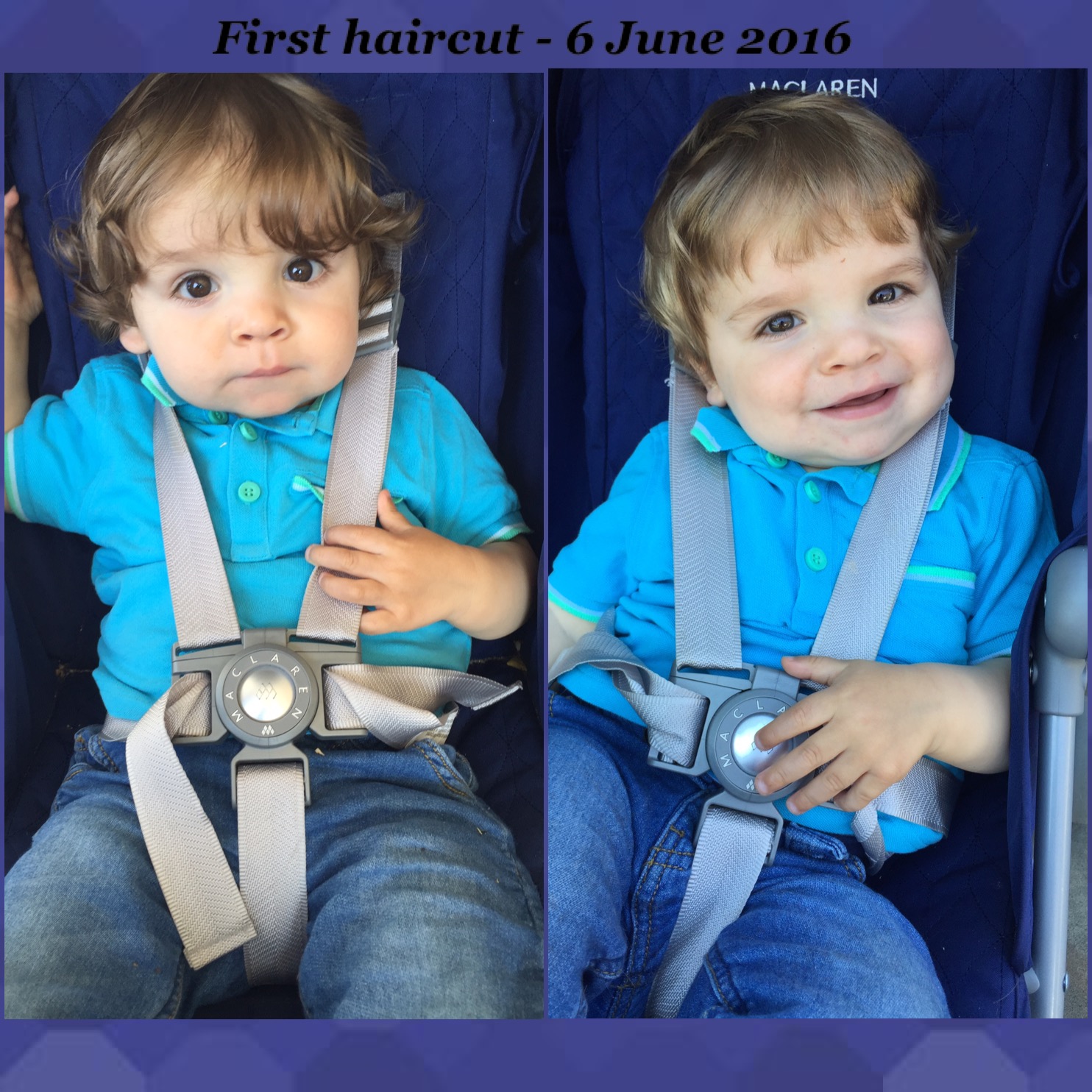
The Boy’s first haircut

The Boy had his first haircut today. This had been a long time coming: like his sister, he was born with quite a lot of hair, and although it didn’t grow quite as quickly as hers, by his first birthday he already had some rather impressive curls all around his head. They looked adorable, almost golden and cherub-like, so much so that some people had started mistaking him for a girl (despite the blue clothes). This in itself was reason enough for my husband to demand that I took the Boy for a haircut, and I had to agree with him that the whole look was quite messy and uneven (something to be expected with baby hair that has never had a proper trim). The fringe, in particular, was starting to be a real problem. I had managed to give it a trim twice before, when it was getting long and starting to go into his eyes, but in the recent while, every time I tried to do it, he would just pull away from my hand and get upset. When the choice became one between giving him, at best, a wonky fringe or plucking his eyes out with the scissors, I knew it was time to book a proper hairdresser’s appointment.

Of course, I took him to my own hairdresser. I’ve been going there for the last five years, and the Girl has also had all her haircuts with him (her first haircut was on her actual birthday, but I couldn’t bring myself to take the Boy in for a haircut on his… It took me an additional two months to build up the courage). In passing be it said, I am not keen at all on the way that men seem to go about going to the barber’s, at least at the place my husband goes to: I’ve never been able to understand why anyone would be happy simply to queue up and go to whomever is next free, rather than go to the same person every time, risking a completely haphazard result that they will then have to pay for! If I’m honest, I think it will take me a really long time to let the Boy join the undiscerning crowd.

Before the haircut itself, this morning, I didn’t think I was going to be too bothered. I did go prepared with an envelope to collect the first locks of hair in, but I didn’t give much thought to the way I was feeling – nor to how the experience itself would actually feel. Matters were helped also by the fact that a friend was there having her hair dyed (the Boy’s haircut was actually slotted in between her having her hair dyed and the styling that would come afterwards): this really distracted me from the magnitude of the experience, although I felt it was important to tell her that she was going to witness very momentous stuff.

It was during the haircut itself, while the beautiful ringlets were falling off (rather faster than I would have liked, a fact necessitated also by his reluctance to being touched or sitting still) that it really struck me: I was excited to see him turn into a proper little boy under my very eyes, but I was feeling sad and wistful too. My baby was definitely no longer a little tiny baby, he had now morphed into a toddler, still angelic but with something of the innocence of babyhood gone. It was as if he had grown by a year in an instant, and this made me excited and sad at the same time.

image

My hairdresser was amazing about it, which really helped. Straight away, he reassured the Boy (so, indirectly, me) with the words ‘You look much more like a boy now, mate’ (I don’t like the word ‘mate’, but I have to accept that my boy is growing up in this culture and he is very likely to be addressed as that many more times in his lifetime…).Then, as if he could perceive my mixed bag of emotions, he waived the charge, saying that he doesn’t charge for first haircuts – as if he could clearly see that, for mothers like me, cutting away their baby’s first locks is like cutting a piece out of their own heart in order to store it in an envelope; the hair will grow back, but that piece of heart will forever stay in the baby memory book.

I know I could easily be accused of senseless sentimentality (it *is* just hair, after all, and as I’ve just said, it *does* grow back)… Nevertheless, after coming home, simply putting away the envelope of hair did not feel enough. I separated one of the longer ringlets and stored it in a clear plastic pocket that I stuck inside of a folded piece of card: this way, we can always keep an even clearer memento of today, and of his babyhood. And I also brought out an envelope that I hadn’t looked at in quite some time, the one which stores the Girl’s first locks of hair (many fewer because, being a girl, she didn’t need such a severe trim). This made me nostalgic for my other baby, the one is is now so big, ever growing in independence and, inevitably, in distance from me. One day, they will both be able to go to the hairdresser’s without me, they will choose who they go to and how much they trim off (and the Boy might well follow in his father’s footsteps and not care whether the person he sees is his regular one or not): that day is a long way off, but even still, in these first locks of hair, I can see its shadow looming large, and I am already dreading it a little bit. I love my babies growing up, but I also wish I could keep them small, safe and mine forever. Whoever knew how much hope and apprehension, how much nostalgia and anticipation, and how much love could pour into a tiny plastic bag together with a lock of hair…?

How I connect with my 5-year-old

Today I want to write about connection. Over the last couple of months, I have been following the 12-week online parenting course created by Dr Laura Markham, of AHAParenting.com. The course, which is now two thirds of the way through, builds on her wonderful book, Peaceful Parents, Happy Kids (for some reason, ‘translated’ as Calm Parents, Happy Kids for the UK market). This has become one of my go-to parenting books, and I often find myself citing from it.

The peaceful parenting philosophy is based on three key concepts: emotional self-regulation (you can’t parent on an empty tank, since you cannot give anything to others if your own tank is empty); connection; and coaching, not controlling. I’m sure I will spend a lot more time in times to come writing about the first and third of these, but today I want to talk about the one that is, to my mind (and to Dr Markham’s too), the most important one of the three: connection.

The idea here is simple: fear is a very poor motivator of good behaviour, and even less, of morals. Children are very unlikely to do as they are told if the only motivator is the threat of punishment. In fact, it is practically impossible to instil a sound moral compass and a good set of values by using mere force. If fear of being caught is the only thing that keeps children from misbehaving, it is easy to see how, as soon as that danger is gone (say, because they are away from us or because they know for sure there is no way we could catch them) they are bound to going back to doing exactly what they want, with no qualms whatsoever. So force and threatened punishment are more likely to teach children how to dodge our surveillance, how to sneak behind our backs in order to get away with whatever it is they want, rather than giving them a sound moral compass. Instead, what does engage children’s cooperation much more effectively is connection. If children feel connected to us (or to anyone else, for that matter), they are much more likely to accept what we tell them, to embrace our values and to do the things that they believe would please us. And, ultimately, what we want to achieve is that, when they are grown up and are faced with a choice between right and wrong, our children choose the right thing not because they are afraid of authority (our own or that of the law), or because they are worried about what others might think: we want them to choose the right thing because they know it is the right thing, because their internal moral compass guides them to it.

My own experience has been most telling. The more connected the Girl feels to me, the smoother our relationship is and the keener she is to cooperate with me. A couple of years ago, when I was going through a difficult time of loss and depression, and she was going through the emotionally explosive toddler years, our connection really suffered, so our interactions were often mutually angry ones: she would (more often than not, deliberately so as to wind me up) do things that I had asked her not to, or she would refuse to do what I asked her to. I would then get frustrated and shout at her, sometimes saying quite hurtful things that came from a place of anger and powerlessness. There were even a few times (and I’m not proud of them!) when I resorted to spanking in an attempt to subdue her. Every control freak (like I certainly was then, and I often tend to be now still) inevitably struggles when coming into contact with another very strong personality that strives to impose its own will: and the Girl is certainly a tough cookie with a lot of will and determination of her own. Our rough edges coming together made each other even rougher, our disconnection was almost clinical, and motherhood was a profoundly exasperating experience all round.

Things are so very different now. I have worked hard to build my connection with her, and our relationship is, most of the time, warm, calm and loving. I have made my limits clear to her and have made the choice to stop raising my voice (as much as possible) and to treat her with respect and understanding. Of course, she still sometimes forgets to stick to the rules (after all, she is only 5, and even she reminds me often that perfection belongs to God alone!). But, most of the time, she stays well within the boundaries because she wants to stay on my good side, she wants us to get on, and she trusts that what I ask her to do is for her own good and for that of our whole family.

Here are a few things that we do to build this connection, and that I believe any parent can do with his or her children:

1. Reading together

imageThis is our special time, and it has always been very meaningful for both of us. When the Boy was a few months old, I decided to protect my special time with the Girl and put him to bed early, so that I could have a bit of one-on-one time with her. He consequently goes to bed at 6:30, and for about 30-45 minutes, the Girl and I read together. First, she reads to me from one of her school books or other similar books of the right level, and I credit this with her very good progress with reading. Then, I read to her. Until recently, Julia Donaldson was a great favourite, and so were a number of other toddler books that we rotated. However, soon after the Girl’s fifth birthday, I felt that she was ready to go to a slightly higher level, so I introduced her to ‘big girl’ books: our first was Roald Dahl’s Charlie and the Chocolate Factory; then, I read Matilda to her, and some books for younger readers by Jacqueline Wilson (at the moment, we are both very much enjoying Rent a Bridesmaid, her latest book).  I very much hope that, as the Girl grows older and becomes a free reader, we can continue reading to each other regularly, and enjoying books together. I hope this always stays our special thing.

2. Shimagearing milkshakes or hot chocolate (any other favourite treats work here)

The Boy is in nursery one day a week, and I use the afternoons as another bonding time for the Girl and me. When the weather allows, we go to our favourite local coffee shop and have milkshakes together, or if it’s rather cold outside, we come home and make Nutella hot chocolate (one teaspoon of Nutella in about 200ml of milk, warmed up in the microwave for 45 seconds – heaven in a cup!). This is a perfect time to catch up, chat and, often, read together.


3. Outings to shows

To date, ever since she was 2, the girl has been to 29 shows: from puppet theatre, to bigger productions with lots of actors, ballets and pantos, around Hertfordshire, in Cambridge and London (including the West End). I usually book way in advance and make sure we have really good seats, and she enjoys them all. Now that she is a bit bigger, she really gets into the stories, crying and laughing along with them. It is a delight to see and share in. And a bonus for me: most of the time we have gone as a family, but at the moment the Boy is too little to be taken to shows, so it is just the Girl and me on most outings, which gives us yet another occasion to bond. I look forward to the day when we can once more go as a family (and we will use the boy as an excuse to go to little kiddy shows like In the Night Garden, the Gruffalo and Room on the Broom), but in the meantime, I’m really enjoying my one-on-one times with her.

4. Playing board games 

Whenever we have a bit of time on our own (such as on the afternoons when the Boy is in nursery, or on a weekend morning when his father is playing with him), the Girl and I play board games together. I’m not a very outdoorsy person at the best of times (unless the weather is really lovely, which in this country it rarely is the case, and this year seems even worse than usual), and I’m not that great with going to the park or soft play centres, but I do like board games. I remember, growing up, how badly I wanted my mum to play board games with me, and how much of a treat it was on the rare occasions when she did – usually, she was far too tired from her long work days to have the patience to do that with me. So, in a way, I’m making up for what I didn’t have myself by playing with the Girl, but she really enjoys the attention and it gives us another opportunity to connect. Our favourite games at the moment are Pop to the Shops and Tell the Time, but we’ve played many other games in our times together.

5. Cards and notelets 

A new addition to my ‘mummy-repertoire’ are the cards and notelets I have started to slip into the Girl’s lunchbox during the holidays. In term time, she has a cooked meal at school, and I think she is too little to have a card in her book bag. But during the holidays, she goes to a holiday club and takes a packed lunch with her. In the last few months, I have started slipping daily cards or notes for her to find alongside her lunch. I only put things like ‘Have a nice day’ or ‘I love you lots’, but she has really taken to them. They tell them that I miss her and think about her and they strengthen our bond even when we aren’t together.

6. And of course, lots and lots of cuddles, kisses and saying ‘I love you’ as often as possible!!

——

One day, I look forward to spa days together, urban weekend escapes, restaurant outings to places other than McDonald’s… All, bonding opportunities, opportunities to create memories which will be only ours. One day, when she is grown up and with a family of her own, I hope she will look back at all these times with fondness and joy, and she will be able to say: “My mother was always there for me”. And in the meantime, I will savour every moment when I can be.


Blog at WordPress.com.

Up ↑